Ordinals are part of our number system - we think about them in terms of races and who came first or last. We use them for dates.
At this level students can name the relative position of an object in a small ordered collection (e.g. of toys), using ordinal numbers such as first, second, fifth, eighth, etc. They are also able to recognise and describe in which order the participants finish a game. Students will recognise that in some activities there may be a single winner, in other activities recognition may be given to those who come first, second or third. They understand that order is dependent on which object/event is identified as the starting point, so distinguish 'third from the door' from 'third from the window' etc. The contexts are spatial (e.g. lining up), temporal (e.g. the second hour of the day) and personal (e.g. I came first).
Using ordinal number words is closely tied to understanding the concepts on which objects or events are being ordered, i.e. comparing heights, comparing volumes, comparing times, comparing areas etc.
Before achieving this, students will be able to recognise whether they win or lose a game or race. They will be able to identify first and last (e.g. of a line of students) but will not be able to identify who is fourth in line or describe the position of the person who is third in line, especially when the starting point is not intuitive.
Later, students will be able to interpret and use ordinal numbers to describe more complex situations, such as “At play, I am going to be the second fairy in the third row” and “I will be the fifth person standing on the left of Ms Callea.”
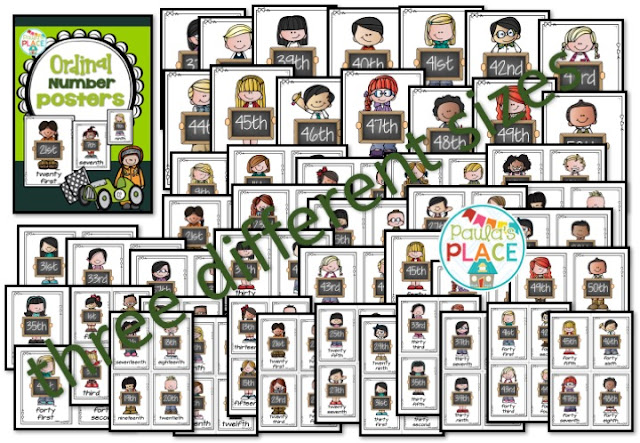
These posters and cards go to fiftieth.
They can be used for sequencing and display.
They come in three sizes for you to use.