Showing posts with label planning. Show all posts

Inquiry Planning

I use this model and the Taking Action is the big idea - this is where we need to get to with a well thought out path and direction for student learning. 

This model can be found on many websites and I am not sure who the original author is. 

kath murdoch inquiry_cycle.jpg

So to demonstrate how I use this model this unit on Gold in Australia is an example. 


Before I plan any unit of work - even an Inquiry - I look at the Curriculum, school planing documents, curriculum audits and reporting requirements. 

This way I don't miss parts of the curriculum and have my eye on the ball for other things we need to cover. 


Then I start with - How can we use any learning to make a difference?

This helps to build the BIG IDEA - use student driven questions and student devised ways to present new learning. 


Then I pull in the Key Understandings which will help drive the teaching and/or independent leaning to help create individual questions for research. Skill development helps me to asses in other areas ie ICT, Personal Learning, Thinking Skills, Communication, English and Maths if they fit. 


This is where I gather information on what my kids know. 
We record our current knowledge, what we want to know. 

Then the Inquiry Model Process begins. 
Tuning In
Finding Out
Sorting Out


Then as a grade we brainstorm possible Inquiry Questions, as I know what the curriculum needs are I can help guide the questions and direction so that they are covered as well as what motivates each student. 

Going Further 
and 
Making Conclusions happen here


The taking action is our conclusion. 

Some kids will help along the way and I have tasks for them to assist in a modified version of an inquiry. Some kids are just not ready for an independent Inquiry Model yet.


Plan with me Sunday


This planning linky is bough to you by 

and 


 This post is about personal planning. I have an Erin Condren Life Planner and I am obsessive about it. 

I have interchangeable covers - you will see more of these next week...

I have a clutch that houses my planner, pens and iPad. 

This keeps everything in one place. 


I have heaps of stickers that stay in the back of my planner. 


My month view helps plan out my month - next week, see the weekly detail.
Where would we be without Washi tape?


Happy planning!

The point of planning pictures

The world has gone mad!
How can people ie educators believe that young writers can just write?
We ask older writers to plan and put in detail so that their writing shows direction, complexity and twists.


If we ask a young writer to just start writing - how can they when they can't write without support?

I was lucky to win 40 days professional leave about three years ago to explore what motivates young writers and how we can improve writing for all young writers. 

I was working for another school at the time and asked the Leadership Team (which I was part of) to trust me and the investment of time I needed to put in place to draw.


I wanted kids to see details in pictures, see emotions in faces, see backgrounds - settings and see story boards. 

I wanted to know that was going to motivate them about putting marks on a piece of paper. 

I read, I googled, I researched, I talked, I argued, I reflected, I procrastinated, I pushed, I worked with many groups of kids, teachers and what I came up with was overwhelming in getting all kids to write.

Step One
Look at picture story books, photos, posters.
What attracts us to these - is it color. background and detail?
Of course it is.....

Step Two
No writing
Draw in grey lead

Step Three
Look at faces
Draw faces, draw playgrounds, draw family, draw stuff in grey lead

Step Four
Add color
Look at use of color, use of dark, light, bright, dull

Step Five
Look at background - where is the picture? where are the people? where is the grass/sky/furniture?


Step Six
Now add starting sounds, sight words


How often have you asked? - What are you writing today? And you got 'I don't know'
A great planning picture stops this - your question changes 'Tell me about your picture' and try ad write the first word, second word, shared pen, modelled writing.

Before you know it they are all writing and loving it. 
The content is much more detailed - just like the pictures. 
The language is much more powerful - the color is powerful.
The setting is included - there is a background.


Step Seven
Draw a planning picture in grey lead
Write
Add colour, detail and background

Step Eight
Excited writers!!!!!!!
Happy teachers.....
Enthusiastic Leadership because everyone is writing......

Win, win, win


Planning for Term 4 - Toys


We started our last planning session with an audit or summary tool of what we had already covered. 
This has our Curriculum Areas and Domains across the top. 
The grey areas are the areas we do not assess against but still need to teach. 
This ensures our kids have the necessary skills when they go up into next year's grade. 

Next step was to look at what we hadn't taught against what we wanted to teach and then see what curriculum areas it addressed. 
The white column that hasn't been coloured at all is PE. 
We have a PE teacher who addresses this for us. Lucky us!


This pages below show the Inquiry Process headings with question prompts. The pile of sticky notes waiting for us to place tasks and assessment on them from what the kids wanted to explore. 

As we are holidays at the moment I haven't yet typed it all up. 
But it will be exciting - I will share when typed.

Here are the sheets with our ideas on them - we also spent time looking at our discovery learning word work, writing tasks and maths planning in detail.  A very fruitful day.


What do we know?

This is a set of photos from way back - but I wanted to post them to show how we start our team planning.

We get our students to record what they know about our new topic/theme.
There is no point teaching what they already know - right?
 
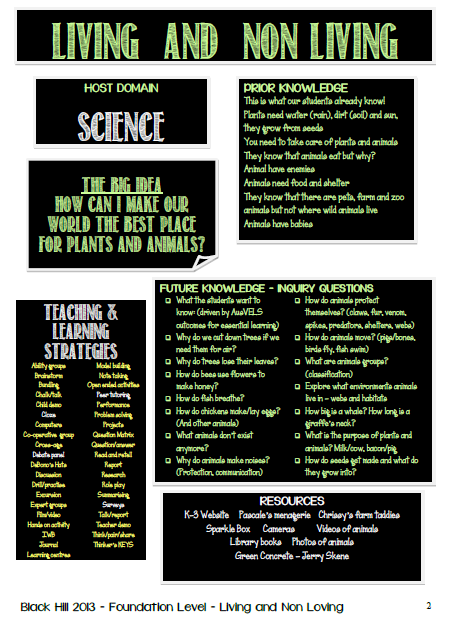
For this topic we use a matrix/table to record what we know about animals and plants and what we would like to know about animals and plants. This is part of a KWHL - but only the first two components.
 
As you look through the pictures, you will see that some students know more than others - this clues us in to who we need to differentiate for or who our experts might be. After the task is done - we talk to students - like a mini conference to get more information and add that to their page, you will be able to see where the teachers have added comments. This allows us to really plan for point of need.
 
It cuts down on wasted teaching and learning time and we tailor topics to our students and always align back to our curriculum.

We are about to do this again for our next topic.


Our Daily 5 planning

I have been asked to share the planning for Daily 5 that is used in my learning space.
The four teachers who share this space (yes - we have 4 grades and 4 teachers working very closely together). This means two of us plan Maths and two of us plan English. Our planning has evolved over time and this is what the planning looks like for my grade and the grade I team teach with for Daily 5.  


So here are the explanations of each section
1 - Contains our Reading focus - Learning Intention, Success Criteria and Café Strategy. At the bottom of this column are the foci for Letters/sounds, Shared Books/Big Books and Explicit Writing Focus.
2. Writing Focus - similar to format of the Reading Focus
3. This is our timing and is in the same format as an anchor chart. One column is what the students do and the other is what we do!
4. Now there are two of them - each one represents a teacher in the space. If I am the first column - I work with the groups on that side this week and then next week I work with the other side. This column also contains the names of students who are at the same reading level.(Guided Reading group)
5. Tells us what day we see the group - the title of the book and the focus for the guided reading task

Teacher Focus –Wed
Book –The Hungry Kitten
Focus Read across the word and get your mouth ready
6. Are the icons to show what order their tasks are (Scrappin Doodles). We also have posters around the room to show what and where they need to be,
7. The tasks for each group for Writing
8. The tasks for each group for Word Work
9. Suggested stories for Listen To Reading
10. Notes pages for Reading
11. Notes pages for Writing

As a team we then copy  the notes pages on Friday and pass them on to the relevant teacher.

If you would like to share your planning -please link up here.


How do I plan a unit of work?

I have been asked this many times - how do I plan my units of work?
 
This has evolved over time and most likely will continue to change as I see a better way - more efficient way to plan.
 
Firstly - I ask my students what they know already. I do not want to prepare tasks if they already know things. I ask them what they want to know about a topic and then reference this with our curriculum. I have started to add the USA Common Core as well.
 
I am working on three units at the moment - Plants, plants and more plants - Pets and Vets and Under the Sea. The reason I do this is because I add things as we learn and then put in extension tasks that other teachers may like to have access to. Then I move slides around - so that they are sequenced and make sense - work on instructions and contents - proofread and then publish! Then celebrate

 These units are not in my stores yet. They are still in draft form.

I make a list of curriculum outcomes that we need to assess against that will challenge my group and then beside each one list learning tasks that would be appropriate.
 
I use power point to put together the unit. On my first slide this is where I can put together my colours, clip art and fonts. This slide is the base slide for the rest of the unit.
 
The last slide tracks where I get my papers, clip art and fonts from. When I insert a new object I check where I get it from and make sure I have acknowledged the source. This way I don't have to come back and remember at the end. I have a terrible memory and  this does helps.
 
I then start the learning tasks using a simple formula using the Inquiry Process.
 
1. Tuning in - what is the focus of the inquiry, what questions are related to the inquiry and who will we work with
2. Finding out - what sources will we use
3. Sorting out - how will we sort, how will we record information and how will we present information
4. Reflection - how will we make connections between ideas, experiences and learning
5. Taking Action - what will we do with our new learning
 
Hope this helps answer some of the questions I have had. If not post a comment and I will get back to you.

A day planning

On the last day of term we had a planning day. Not all schools have them, some have a few a year and some have one a term.
 
I am part of the coaching team that meets to establish the protocols for these days.
 
We decided that we needed to plan for an Inquiry Approach so that all teams were approaching this with the same information and similar ways of recording information.
 
We were trying to do an integrated approach but not hitting as many curriculum areas as we wanted.
 
So Step One - Curriculum Summary
This types of documents have been around for a while and Kate that shared my grade talked to the coaches about doing this.
So I put the domains and dimensions across the top. As a team we then added our topics and went across the spreadsheet highlighting the areas that were part of that topic.
This exposed gaps and then we looked at what we needed to teach and come up with our topic.
The grey areas are areas we teach but do not assess.
 
 
Step Two - Find out what our students know and want to know about the topic. We got
them to write down or draw and then compiled them onto the charts below. This would drive our whole planning day.

Step Three- Professional Reading prior to the day. Each team member took hard copies of our curriculum home to read and they needed to be the 'expert' and have a voice for that part of the curriculum.
With a new curriculum - this was a great way to become familiar with and be accountable.
 
Step Four - A big brainstorm
We spread out and all wrote and all contributed to our plan. The different coloured sticky notes represent different parts of our new curriculum. I was so impressed with out efforts.
We came up with Inquiry questions, tuning in tasks and assessment tasks.


Step Five - Whole School Share
 
Built into this day was a 15 minute share by each team. Our Principal was so moved she couldn't speak! A hugely successful day by us for our students.
 
 
That is what it is all about!
 
Step Six - to get this to a planner that is portable....keep reading and see the first draft


Related Posts Plugin for WordPress, Blogger...