Reflections - how do you manage this in a busy classroom?

In a busy classroom it is hard sometimes to stop and reflect on learning. 

It is such an important step to help consolidate learning, check on understanding, redirect misconceptions and set new goals. 

For me it is the most important step in the learning process. 

I have created a set of templates that will suit any grade level and any topic - even Mathematics!

These tools can be used for students to share their understanding and reasoning skills when exploring new concepts for any topic.


You may choose to use one per student, have them work in pars or as a group.


PMI – record the Positive, Minus and Interesting facts about the topic
Alphabet Key – record what you know by using the alphabet to organize your knowledge
Venn Diagram – choose two aspects of a topic to compare: what is similar goes in the centre
I see, I think, I wonder
Fishbone – topic goes in the fish head and what you know is recorded on the fish bones grouped by headings
Diary – record what you do each day and set a goal at the end of each week
Journal – record what you know and what is next (with learnt and learned options)
KWHL – share what you Know, Want to know, How you might find it out and new Learning
Mind Mapping – show what you know and add to this you progress through the task/unit of work
Y chart – what it sounds like, feels like and looks like
Think board – great for showing the same concept in four different ways
Lotus Diagram – topic goes in the centre and record what you know around the topic. The word in the green goes in the next green space and then record details you know about this around the word. Continue with each color. Two printing options.
Cycle – is there a pattern of how a task needs to be done?
Faces – color the face that is relevant to you and the task

Glossary – list new or interesting words/terms and then add a definition


Ordinals - Racing to be First


Ordinals – Racing to be First
111 pages


Use the weekly planner to know what the relationship is between the different parts of the lesson and the resources. 


Some components are provided in options for black and white.


Provided are the following learning tasks 
- Sequence the racing cars 
- How do you get ready in the morning?
- What happens in your day?
- Sequence the trains and the carriages 
-  Match the numeral to the word
-  Order heights of kids in the room and cards
- The Caterpillar - sequence the food he ate cards
- Charts for your room for ordinal numbers to 20
- Flashcards to use for sequencing, ordinals and matching 
- Sequence days of the week, months of the year and attach the correct ordinal 

- KWHL for ongoing assessment  


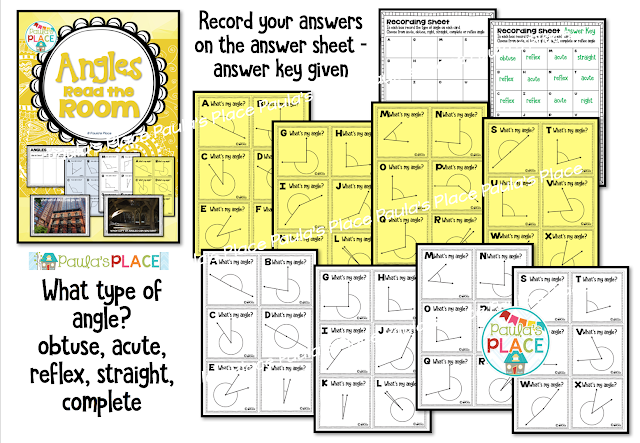
Angles - Read the Room


Angles – Read the Room

26 pages


This Angles – Read the Room pack aims to help your students discover the types of angles and the names we give them. 


Share the two photos with your grade and ask what sorts of angles they see. 

Use the ANGLES page to record what your grade knows or what individual students know. This can be added to as you progress through the tasks. 


The first set of cards are to determine if the angles are acute, obtuse or right angled. Print the cards (either blue background or black/white). Students record the type of angle by checking the correct box on the answer sheet. There is an answer key.


The second set of cards are to determine if the angles are acute, obtuse, right, complete, straight or reflex angled. Print the cards (either yellow background or black/white). Students record the type of angle by writing the name of the angle in the correct box on the answer sheet. There is an answer key.


Missing Numbers up to 120


Helping to create that real sense of number takes lots of consolidation. 
We need to provide lots of opportunities for exploration and tasks that will pace learning are so important. 

This pack provides colored mats that you can laminate and write on with whiteboard markers for long term use. 

Then there are two sizes of black and white versions that you can copy as is or onto colored card. 


Print your own Word Book...


My Word Book – A Personal Dictionary 
58 pages   


 There is a colored version and a black/white version. 
The black and white version can be copied onto colored paper to give you a third printing option. 
 The booklet contains words from various word lists that we all use in classrooms. 

They contain the most used words that our students use in their daily writing. 
There is space to add your own words. 
By adding the student’s words the booklets become point of need and are tailored to each writer. 
So, keep them close when it is writing time. 
 Copy your selected version – each copy makes two books. 
Staple the pages together and cut in half to make the two copies. 
There are instructions to show you how to do this.


Happy word building with your writers.

Story Book Sunday is back


I just love picture story books and it doesn't matter what grade you teach - our kids love them too!

If you have blogged about a great book for fractions - there is a link up at the bottom of this post.

I was waiting for this book to arrive to match the 'Farm Theme' Fractions I was doing and it finally arrived. 

This book is a great introduction to fractions. The author, Taryn Souders allows you to consolidate basic understanding before you begin to develop understanding around adding and subtracting fractions. The illustrations by Tatjana Mai-Wyss are just delightful and really compliment the text. 


The discussions around each page and different fractions make the understanding of these concepts colorful, engaging and fun.

The above page is about the fractions in the cow's swimsuit - what fraction is red, white and blue?

You can have fun while learning by drawing and adding labels to the pictures in your Math Book or on a whiteboard. 

My kids really enjoyed working through this pack on fractions based on a Farm Theme


Add your blog posts here about great fraction books!

An InLinkz Link-up

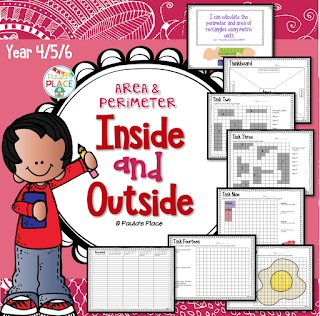
Area and Perimeter - Inside and Outside


Area and Perimeter – Inside and Outside
31 pages


This is based on the Australian Curriculum at Year 4/5/6 levels. 
The measurements are in metric.

There are “I can’ Statements’, a weekly planner, an assessment recording sheet and the following tasks - 

Task 1 - Perimeter of regular shapes
Task 2 – Area of regular shapes 
Task 3 – Perimeter of irregular shapes 
Task 4 – Area of irregular shapes 
Task 5 – Calculate area and perimeter
Task 6 – Design a picture for area and perimeter
Task 7 – Shapes with the same area
Task 8 – Formal calculations
Task 9 – Paddocks with a difference
Task 10 – The area of your name
Task 11 – Design a house – research how the area of a house is measured
Task 12– Design a garden bed
Task 13 – Desks in your class
Task 14 – Area of an object

Task 15– Zoo or Farm? 


Related Posts Plugin for WordPress, Blogger...